Guangbo Yu

About

I am a PhD candidate at UC Irvine, in Biomedical Engineering and Radiological Sciences. I work on foundation models and multimodal learning, usually where the data is small and the evaluation is the hard part.

Most of my work starts from the same constraint. Clinical datasets are limited, and the thing worth predicting, how a tumor is actually behaving, sits inside a biopsy. Imaging is the opposite: non-invasive, repeatable, and already part of standard care, but it shows anatomy rather than biology. My PhD is about closing that gap with models pretrained elsewhere, so that the biology is what gets learned here, not the representation.

A version of the same question comes up outside medicine: is the model using the image, or something easier? Post-training a vision-language model, I compared reinforcement learning against plain supervised fine-tuning on the same data. RL earns its place where reasoning pays, about ten points on chart questions, and its gains mostly vanish when the image is blacked out, as they should. Fine-tuning's partly survive: the model has learned answers it can give without looking. Applied to two 3D CT benchmarks, the same test showed that most of their published accuracy was reachable without the scan.

Both lines of work arrive at the same place. A number is worth what you checked it against, which is why the medical models are held against stained tissue and the language models against a blacked-out image.

Before the PhD I spent two years as an NLP engineer at Tencent QTrade, building named-entity models for a brokerage chat platform with more than 500,000 daily users. That is where I learned what a wrong prediction costs once it is serving live traffic. Away from research I photograph landscapes, mostly in the American West.
Selected Work

All projects →

Reading tumor biology from a scan the patient already gets

Pancreatic cancer, mouse 9.4T MRI and patient CT. eBioMedicine, in press.

Reading a pancreatic tumor's immune and stromal makeup takes a biopsy today. We asked whether one imaging pipeline can read it from mouse MRI and from the CT patients already get.

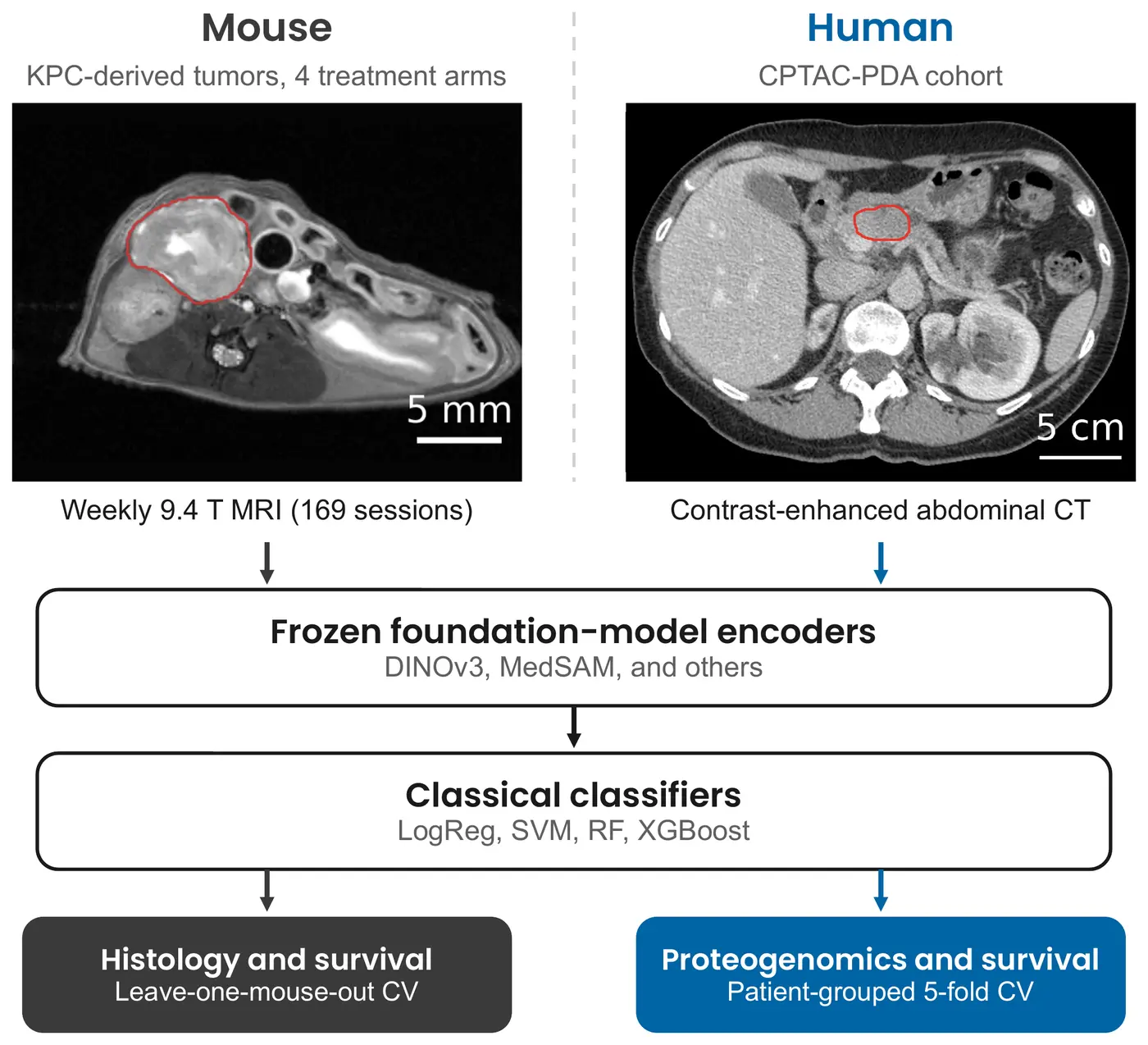
Methods. Mouse: KPC-derived tumors in 4 treatment arms, imaged with weekly 9.4 T MRI (169 sessions). Human: the CPTAC-PDA cohort, contrast-enhanced abdominal CT. Both go through frozen foundation-model encoders (DINOv3, MedSAM and others), then classical classifiers (LogReg, SVM, RF, XGBoost). Mouse predictions are evaluated against histology and survival with leave-one-mouse-out cross-validation; human predictions against proteogenomics and survival with patient-grouped 5-fold cross-validation.
BiomarkerMouse MRIPatient CT
CD8 infiltrationCD8 density (IHC) · CD8A protein0.940.81
Stromal collagentrichrome collagen · COL1A1 protein0.960.78
CD8:CD68 balanceCD8:CD68 density · CD8A:macrophage protein0.940.86
Antitumor responsehistology composite score · cytolytic activity (RNA)0.950.80

AUROC per biomarker, each against its own ground truth (mouse · patient). Fine-tuning the same network end to end peaked at 0.63 and 0.70.

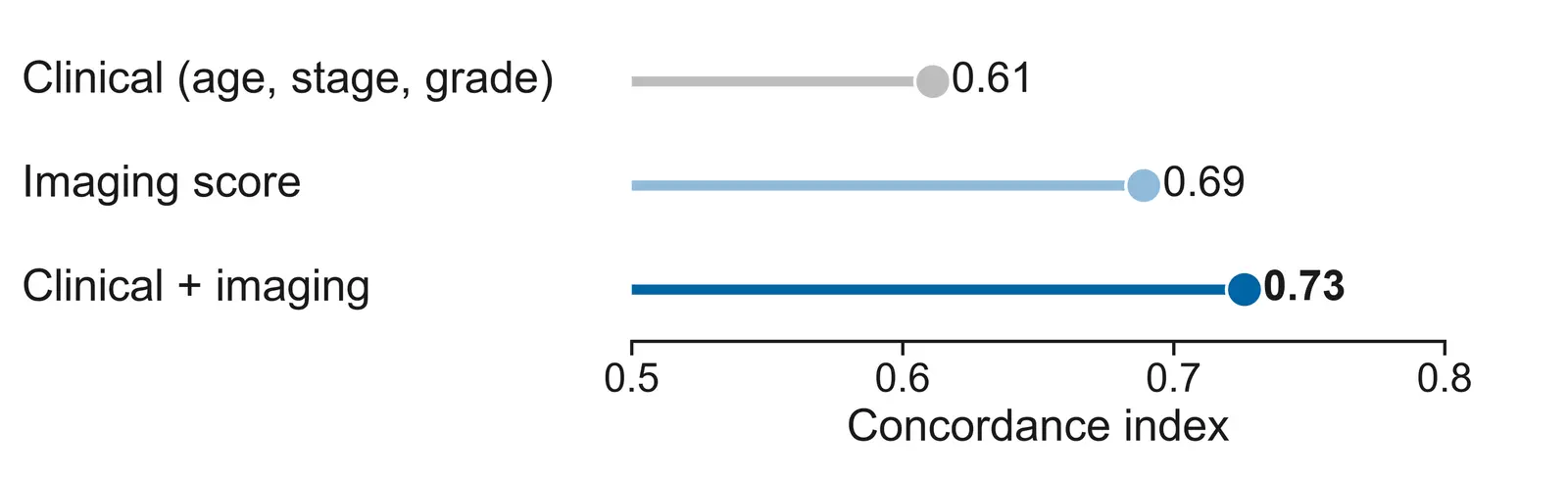
Survival concordance index in patients: clinical variables (age, stage, grade) 0.61; imaging score 0.69; clinical plus imaging 0.73.
Added value over clinical staging, in patients: the CT score stays prognostic after adjusting for age, stage and grade (HR 1.87 per SD).

Mouse MRI, checked against whole-tumor histology, can nominate CT biomarkers that turn a routine scan into a noninvasive readout of tumor immunity and stroma.

Telling early whether an immunotherapy is working

Journal of Translational Medicine (2024) and Diagnostics (2025).

Judging a liver-cancer treatment normally means waiting for the tumor to visibly change size, which is slow and sometimes misleading. These two papers predict the outcome from MRI taken earlier, first with radiomics and then with a single network that segments the tumor and predicts response together. Both are checked against the tissue rather than against a held-out split alone: the imaging measures track histology at r = 0.94, and predicted cell death lands within 0.013 RMSE of the stain.

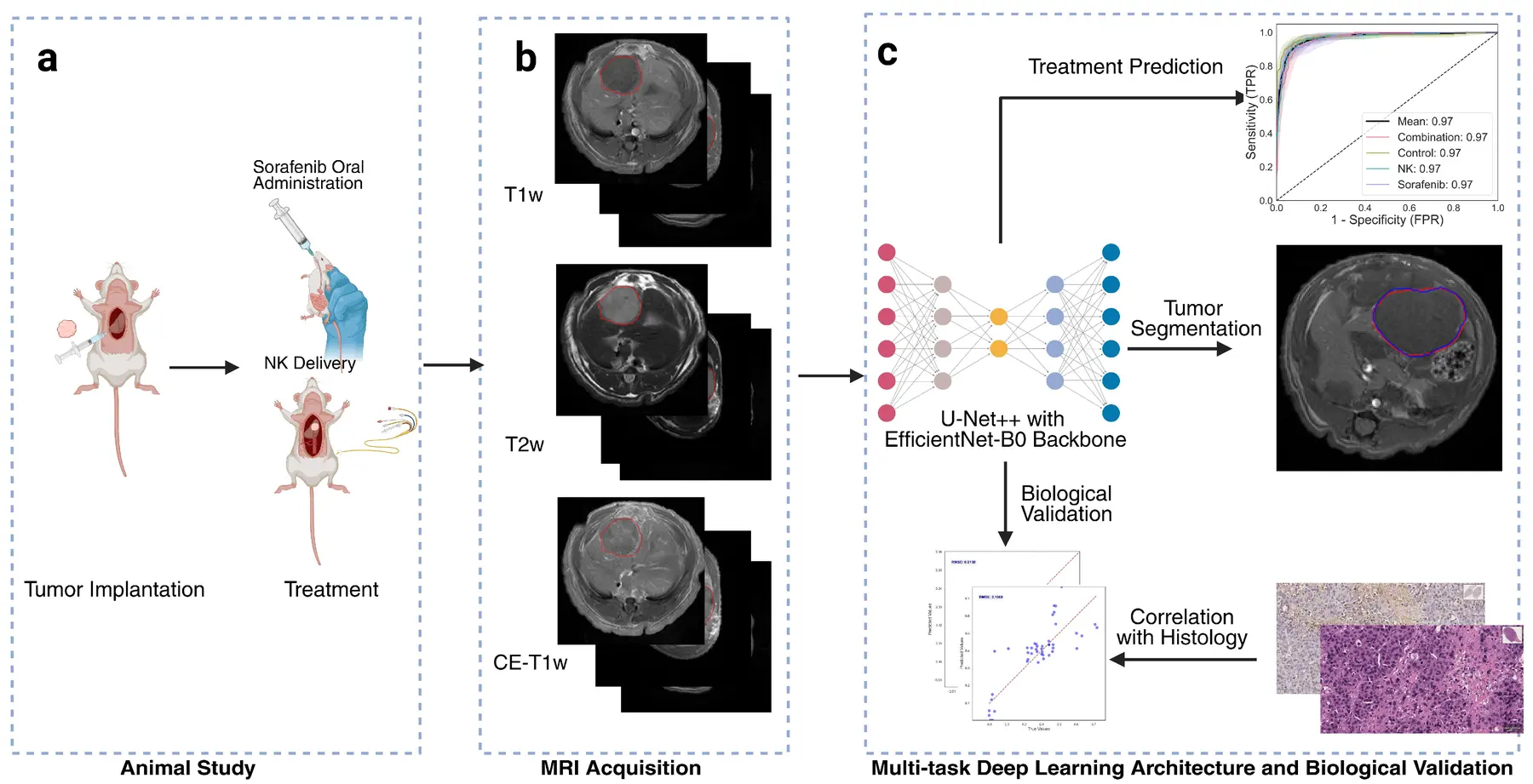
Study design in three panels: rats with implanted liver tumors receive sorafenib and NK-cell therapy; T1-weighted, T2-weighted and contrast-enhanced MRI are acquired; a U-Net++ network with an EfficientNet-B0 backbone segments the tumor and predicts treatment response, and its outputs are correlated with histology.
Study design of the Diagnostics paper: one network segments the tumor and predicts response from MRI, and its outputs are checked against histology. Figure 1 of Yu et al., 2025, CC BY 4.0.

What reinforcement learning adds to a vision-language model

Qwen3-VL at 2B and 8B, supervised fine-tuning against RL from verifiable rewards, on photo, chart, and medical questions. Open source.

RL wins where reasoning pays: on chart questions it keeps its step-by-step reasoning and goes from 69.7% to 80.1%, about ten points above every short-answer model. Its gains also need the image. With a black image in place of the real one, the RL model answers no more questions than the base model in five of six settings, while supervised fine-tuning on the same questions answers up to 15 points more, having learned answers it can give without looking. Pointed at two 3D CT benchmarks, the same checks found most of their published accuracy reachable without the scan.

pinned data frozen test sets, test images kept out dataset screen image must matter, RL must get a signal train three arms SFT, GRPO, SFT then GRPO score every model 9 test sets, 2 prompts each one evaluation harness, built before any training official scorers · image-audited LLM judge · black-image test · paired 95% intervals
The harness comes first: it decides which datasets RL can learn from, then scores every arm on the same questions.

Background

University of California, Irvine

2022 to present

PhD, Biomedical Engineering, working across Radiological Sciences on NIH-funded imaging readouts of cancer immunotherapy.

Tencent QTrade, NLP Engineer

2020 to 2022

The job had two halves. On the research side I led the team that pre-trained domain BERT models and tuned the algorithms other products were built on. On the engineering side I took named-entity recognition for a brokerage chat platform from an LSTM pipeline to an ALBERT-based model (macro-F1 77 to 88), served under 100 ms at p95 on CPU and rolled out by canary from 5% of users to all of them.

data in 11 languages MultiCoNER full-data fine-tuning XLM-RoBERTa adversarial training data augmentation track-specific fine-tuning Chinese, multilingual, code-mixed ensemble 7 models, majority vote pseudo-label fine-tuning gold + pseudo- labelled data pseudo labels come from the vote
Our ACL 2022 work on multilingual NER, which became the foundation model our team built on: third in the multilingual track at SemEval-2022, fourth in code-mixed and seventh in Chinese.

University of Southern California

2015 to 2017

MS, Computer Science. BS in Software Engineering from the University of Electronic Science and Technology of China before that.